

select search filters
briefings
roundups & rapid reactions
Fiona fox's blog
The Office for National Statistics (ONS) have released provisional counts of the number of deaths registered in England and Wales in the week ending 16 October 2020.
Prof Sheila Bird, Formerly Programme Leader, MRC Biostatistics Unit, University of Cambridge, said:
“Key data from Office for National Statistics are provisional counts of COVID-mention deaths by date of occurrence.
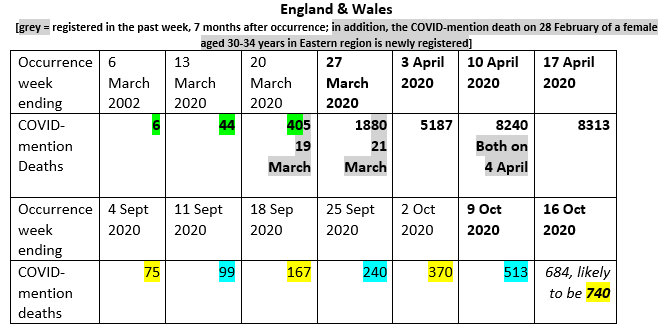
“My table, updated from last week, contrasts COVID-mention deaths in England & Wales (by week of occurrence) in early March 2020 and early September 2020. Not all deaths which occurred in the week ending 16 October 2020 have yet been registered so that the likely final count will be nearer 500.
“During the first wave, COVID-19 deaths increased by a factor of 10, week-on-week, in the first three weeks of March 2020. The weekly rate of increase then moderated to below doubling in the first two weeks of April.
“As we approach UK’s second wave, COVID-19 deaths in England & Wales are more than doubling fortnightly (running rate of 2.1 = {167+240+370+513+740}/{75+99+167+240+370}; compare yellow shading; also turquoise shading). Hence, we may expect that 1000 COVID-mention deaths may have occurred in England & Wales in the week ended 23 October 2020.
“The rate of increase in 2nd wave for England & Wales is currently lower and slower in than March 2020, when it was initially 10-fold, which is the good news.
“The bad news is that the rate has not started to abate. By changing our close contact patterns now, as Scotland’s central belt did from 13 October for 2-weeks and Wales did yesterday, we need to moderate down the rate of increase over the coming weeks, and the sooner the better.
“But we shall also need to sustain reduced contact patterns for months, not just weeks, to see us through the winter. Serial circuit-breakers can help us rein- in exuberances. NB: Of this week’s five late-registered COVID-mention deaths, the earliest was on 28 February 2020: a female, aged 30-34years who died in the Eastern region. All five are likely to have been coroner-cases.”
Prof Kevin McConway, Emeritus Professor of Applied Statistics, The Open University, said:
“The weekly ONS data release on deaths, based on death registrations, provides sobering reading. The latest week covered is 10-16 October. The total number of deaths from all causes in England and Wales that week was about 7% above the average figure for the same week in the previous five years, and indeed the weekly deaths have been above the five-year average since the beginning of September. This would be concerning whatever the actual cause of these excess deaths is, but the ONS data indicate very clearly that the main cause of the excess is Covid-19. Deaths involving Covid-19 registered in the week ending 16 October were 53% higher than the previous week. Looking over a longer time period, the number of deaths registered that week involving Covid-19, 670, was about 8.6 times the number (78) for the first week in September. Since the first week in September, the number of deaths involving Covid-19 has doubled roughly every two weeks. That’s a much smaller rate of increase than at the start of the pandemic in the UK last Spring, but so far there’s very little sign that the rate of increase is slowing. The overall level of deaths not involving Covid is currently roughly at the 5-year average level.
“The pattern of deaths does vary somewhat between the different English regions (and Wales), but the overall picture is again not at all encouraging. Total deaths from all causes are higher in the most recent week than the week before in Wales and in all the English regions except the South East, where the number is the same as the previous week, and Yorkshire and the Humber, where it is very slightly lower than the previous week. For all the regions except the South East, and for Wales, deaths in the most recent week are higher than the five-year average, particularly so in the North West, the West Midlands, and the North East. Deaths involving Covid-19 are up in all regions and in Wales in the most recent week compared to the week before.
“Looking at the locations where deaths occur, it remains the case that deaths (from all causes) at home are running at roughly 100 a day more than the five-year average, while deaths in hospitals are below average. Further details on deaths at home were published by ONS last week1, but that bulletin could not entirely get to the bottom of why these extra deaths at home are happening. Another disturbing feature of this week’s data is that deaths (from all causes) in care homes in England and Wales are now higher than the average for the same week in the past five years. The number of excess deaths in care homes is not large – 90 for that week – but the numbers of deaths in care homes have been lower than the five-year average for every week since mid-June until this most recent week.
“These statistics are based on death registrations, so they take longer to process and collate than the data on deaths in Government briefings or on the Government dashboard at coronavirus.data.gov.uk. But, unlike the daily figures, the deaths involving Covid-19 are not linked to a previous positive test, but are based on what was written on the deceased person’s death certificate. The figures I have discussed above, for deaths involving Covid-19, include all deaths where Covid-19 is mentioned anywhere on the death certificate. In some cases, therefore, the underlying cause of death would not have been Covid-19. However, other ONS analyses have established that the great majority of deaths where Covid-19 is mentioned on the death certificate are indeed recorded as having Covid-19 as the underlying cause.”
1. https://www.ons.gov.uk/peoplepopulationandcommunity/birthsdeathsandmarriages/deaths/articles/deathsinprivatehomesenglandandwalesprovisional/deathsregisteredfrom28december2019to11september2020, and see also https://www.gov.uk/government/publications/excess-mortality-in-england-weekly-reports.
Prof Sir David Spiegelhalter, Chair, Winton Centre for Risk and Evidence Communication, University of Cambridge, said:
“There continues to be 100 extra non-covid deaths each day in private homes – one-third more than usual, and showing no sign of decreasing. Perhaps this is a long-term effect of the pandemic. If there is good end-of-life care, then this could be a positive change, but it is unclear if this is the case.”
https://www.ons.gov.uk/releases/deathsregisteredinenglandandwalesprovisionalweekending16october2020
All our previous output on this subject can be seen at this weblink:
www.sciencemediacentre.org/tag/covid-19
Declared interests
Prof Kevin McConway: “I am a Trustee of the SMC and a member of the Advisory Committee, but my quote above is in my capacity as a professional statistician.”
Prof Sir David Spiegelhalter: “DJS is a paid non-executive director of the UK Statistics Authority, that oversees the work of the ONS.”
None others received.