

select search filters
briefings
roundups & rapid reactions
Fiona fox's blog
NHS England have published the latest figure for reported deaths in hospitals in England – an additional 383 deaths since yesterday, bringing the total to 22,432.
Prof James Naismith FRS FRSE FMedSci, Director of the Rosalind Franklin Institute, and University of Oxford, said:
“Today’s number of new deaths serve as a painful reminder that the way down from the peak of deaths is much much slower than the way up. ONS data tells us that more people have died this year than at this point last year. This ‘excess’ of deaths over what we expect is the truest measure of the impact of the virus. Importantly, the number of excess deaths is not fully accounted for by counting all Covid19 deaths (suspected and confirmed). There are many theories as to why more people, who appear not to have died from covid19, have died during the epidemic, what is needed is detailed scientific investigation and analysis. If we don’t know what is causing these excess deaths we won’t know how to reduce them. It is always true in science that many seemingly plausible theories are proven wrong by data.
“I am not and have never been persuaded that our time at this moment is well spent comparing the total number of headline deaths UK with France, Italy or Spain to identify the worst performer. We have done very badly in the first wave; that these other countries have done badly too, does not change the harsh truth that our response to the first wave was inadequate.
“Given the death toll is over 30,000, even 5,000 deaths difference between these countries headline figures is the context of these horrific totals a relatively small difference. I want to stress that each of those 5,000 deaths is a tragedy and each one should drive us to do better. In terms of the speed at which the virus spreads, however this is a few days difference in the timing of lock down. Demographic factors can also account some of the differences in headline totals. In time, ONS like data on excess deaths in other countries coupled to analysis of the causes of death will provide important lessons for the UK. There will have to be a formal process to ensure we learn these lessons.
“My deep concern, is that obsessing who is the worst at the moment, is to miss the much bigger lesson (10,000s of deaths) that is in plain sight. Germany and South Korea, comparable in population terms, have much lower number of deaths. Germany by having a strong testing network identified the spread of the virus more accurately than the UK and locked down earlier in the virus wave than we did. South Korea has built an impressive test, trace and isolate (TTI) infrastructure. The South Korean model is a three legged stool, get one part wrong and the whole thing falls, irrespective of how impressive the other two legs are.
“There is no evidence that the virus has mutated in a way that has reduced its potential to spread and cause illness in a possible second wave. Unless our estimates of infected individuals are vastly underestimated, the % of the population with no immunity to the virus is sufficient to sustain a possible second wave. An uncontrolled second wave would overwhelm the health service and could kill many 10,000s of people. We are still diagnosing well over 10,000 new infections a week; the virus has not gone away. The work of expert epidemiological modellers such as Professor Ferguson are essential for meaningful estimates of the probability, scale and timing of a second wave, but it seems plausible that we will face a second wave and we should prepare for it.
“Since a vaccine is some time away, the surest way to reduce deaths is to reduce infections. There are only two proven methods of controlling infection, “hard lock down” and “TTI” with softer social distancing.
“If we are going to rely on a hard lockdown, then the lesson we can draw from the first wave is brutally simple, have a testing regime that allows identification of a second wave of infection as quickly as possible so we can lock down as fast as possible.
“If we aspire to avoid locking down and still reduce death toll in a possible second wave, then we do not have a moment to lose. All three legs of ‘TTI’ needs sorted out, not just simple headline test numbers. To a first approximation, we should try to copy the South Korean model. We also need to understand and implement; the social distancing measures tolerable and effective in the UK; the public health measures that are effective (hand washing, barrier methods, sanitisation); the most effective shielding of the most vulnerable. The epidemiological dynamics of the spread in the UK needs careful study so that we can use targeted methods to limit the viral spread, this will guide schooling, transport and care homes. We need to design a testing regime that gives us the most advanced warning of a second wave. There are hopeful signs that science will produce medical treatments to significantly reduce the death toll of the virus but a “miracle” cure is not yet in sight.
“I am confident that the UK can do much better in the second wave. However, I am surprised given the awful lesson that we have learned about the speed of the epidemic that we think we have the luxury of time. We do not and the work required to get anything other than a hard lock down strategy needs intense focus. Just getting the South Korean model working here is a massive effort, it can not be conjured up by wishful thinking.
“Arguing over who has claimed the worst headline performer in Europe when there are 10,000s of lives at stake seems to me pointless at best in this moment.”
Prof Carl Heneghan and Dr Jason Oke, Centre for Evidence-Based Medicine and Nuffield Department of Primary Care Health Sciences, University of Oxford, said:
“Our ‘COVID-19: Death Data in England – Update 7th May’: https://www.cebm.net/covid-19/covid-19-death-data-in-england-update-7th-may/
“Today’s reported figure is 383 deaths in hospitals in England. These deaths are distributed back to the 19th of March: 243 (63%) of the deaths were in the last week, and 140 (37%) occurred more than 7 days ago.
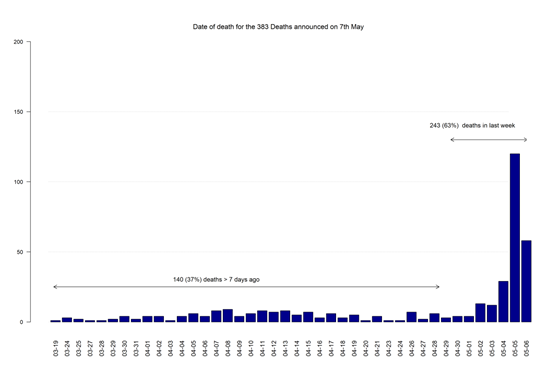
“For comparison: the reported deaths in hospitals in England on the same weekday 1, 2 and 3 weeks ago were:
https://www.england.nhs.uk/statistics/statistical-work-areas/covid-19-daily-deaths/
All our previous output on this subject can be seen at this weblink:
www.sciencemediacentre.org/tag/covid-19
Declared interests
None received.