

select search filters
briefings
roundups & rapid reactions
Fiona fox's blog
The below, written by Dr Gail Carson, is not in response to any specific developments directly but rather her thoughts and comments on what has happened so far in the outbreak.
Dr Gail Carson, Director of Network Development at ISARIC (International Severe Acute Respiratory and Emerging Infection Consortium), and Consultant in Infectious Diseases, University of Oxford, said:
“We have passed the UK peak but at what cost? We commemorated the deaths of our Health Care Workers (HCWs) last week. During SARS in 2003 HCWs died due to the SARS virus and many said, ‘never again’. Here we are again! What and how can we learn from their deaths? These lessons do not need to wait until the end of the pandemic.
“There needs to be a strong health care system in the broadest of terms; from primary to secondary care and community care facilities (including outreach outpatients, nursing homes) whether government, local authority or, privately run. Why; because outbreaks find the cracks in all systems and with a pandemic that means lost lives. The scaling up of capacity within the NHS seen recently is extraordinary and credit to all of those involved.
“So passed the peak in the UK and waiting to hear the official plan for the way forward from the UK & Scottish governments next week. Caution is still very much required. Already there are some references in the public domain of what those measures may or, may not look like with varying evidence bases; face coverings in public, physical distancing but what distance, on going shielding but for how long, home temperature checking, increased testing, contact tracing via an app, community studies by public health agencies to better understand how many have been infected to date, widespread hand hygiene opportunities, vaccine studies and clinical trials to determine which drugs treat COVID19. Where many questions remain, many decisions remain to be made. The ‘new normal’ of living with the virus will be shaped by all of us. Therefore, engagement with all of the population and how that might be occur, be galvanised and trust maintained will be critical going forward. This is the main lesson we have learned from major outbreak responses in other parts of the world.
“The Scottish Government released on April 23td its COVID19 decision-making Framework regarding transitioning out of lockdown where the challenge faced by Scotland is presented with an approach & principles outlined. This living document contains a succinct description of the approach and principles used to aid in decision-making. It clearly outlines the approach to combine public health measures, with science and innovation spearheaded by strong leadership and community engagement. We have witnessed pragmatic decision-making where the scientific evidence has been lacking but public health experience/approach and common sense have prevailed.
“The WHO has an eagle eye’s view of the world and their advice is always worth considering such as what to consider when loosening public health and social measures. The WHO advises basing those decisions on scientific knowledge and real-world experience taking into account e.g. economic factors, human rights, food security and public sentiment and adherence to measures. Their recently released document covering such considerations outlines the type of scenarios that maybe faced such as recurring epidemic waves interspersed with periods of low-level transmission.
“One of the unusual points with this pandemic is that we have to keep responding whilst in parallel preparing for what might come next; building in resilience, strengthening the infra structure yet trying to establish some form of recovery; a fine balancing act. The usual spectrum is preparedness then response and finally recovery.
Fig 1 Adapted GOARN Outbreak framework for COVID19 – Helicopter view –
Response & Preparedness
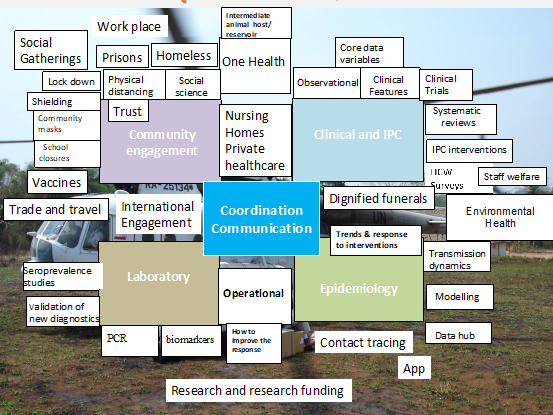
“Where are the weak areas, where is the disease likely to spread, how do we prevent it spreading? Those Achilles tendons for the virus may change over time and constant vigilance by public health and government will be required. Outbreaks tend to find the weaknesses in the health care system, economies, society and politics. This can be replicated across the globe as the virus knows no borders and until we have accessible medical countermeasures for those who need them global solidarity is required like never before. UK Government and DfiD have taken laudable steps with regard to research and development leadership and funding. In fact, research funders have stood up across the world (GloPID-R) and many efforts have been captured on the UKCDR website to assist with future coordination of funds.
“Progress to counter the virus other than the R0 has been made since lockdown begun as we eagerly await vaccine and clinical trial results. In the meantime we will have to continue to look at our surroundings through a different lens. Maintain those improved hygiene practices. Follow the guidance provided by the government and public health to stay safe and healthy. Learn how to risk assess our safety and implement the appropriate measures. Be compliant and engage with contact tracing. Be patient and kind with each other. What more could be done regarding preparedness for the various scenarios that could occur as the pandemic continues to unfold? Forward thinking and international outreach will continue to be critical in the planning required now.
“Global solidarity by all, for all.”
All our previous output on this subject can be seen at this weblink: www.sciencemediacentre.org/tag/covid-19
Declared interests
None received.