

select search filters
briefings
roundups & rapid reactions
Fiona fox's blog
The Office for National Statistics (ONS) have released their latest figures on deaths in England and Wales from COVID-19.
Comments sent out on Friday 15th May
Prof Sir David Spiegelhalter, Chair, Winton Centre for Risk and Evidence Communication, University of Cambridge, said:
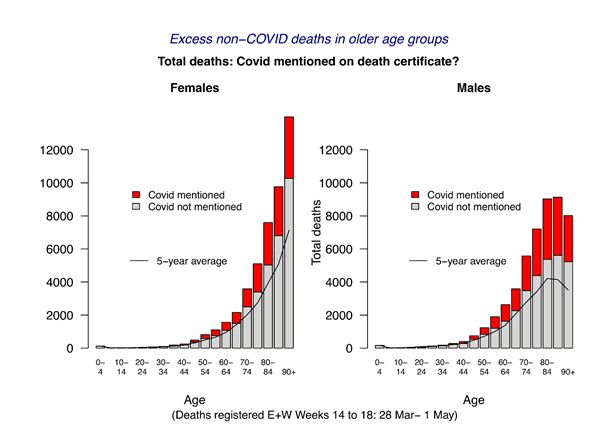
“A positive side of lockdown? Careful analysis of the latest data from the Office for National Statistics shows that young men aged between 20 and 24 have shown a significant drop in deaths during lockdown. Over the 5 week period between March 28th and May 1st, 58 such deaths from all causes were registered in England and Wales. The five-year average for this period is 89, meaning there was a 35% reduction in deaths. If we exclude the 10 COVID-related deaths, then deaths from all causes other than COVID reduced by 45%, nearly half. Females in this age-group showed no change from normal.
“Men of this age typically show a ‘bump’ of increased risk of death from non-natural causes such as accidents and other consequences of risky behaviours. Lockdown appears to have ironed this out. See this web article https://wintoncentre.maths.cam.ac.uk/covid-analysis-excess-deaths-updated-15th-may/”

Comments sent out on Tuesday 12 May
Prof Sheila Bird, Formerly Programme Leader, MRC Biostatistics Unit, University of Cambridge, said:
“Very sadly, the additional deaths registered in England and Wales during the 8-week COVID-era from 7 March to 1 May 2020 number over 46,000, over 33,000 having been directly COVID-mention deaths. The additional information that ONS provides is the sex and age-distribution (under 45 years, 45-64 years, 65-74 years, 75-84 years, 85+ years) for COVID-mention deaths by registration-week so that, for males in particular, we can assess the additional death-toll by age-group for trios of registration-weeks by comparing against the male deaths that would have been expected in each trio and age-group, based on the past 5-years. We know that the directly-exacted COVID toll is greater for men than for women and increases dramatically with age. We do not know, as yet, whether the same (or different) patterns by sex and age-group are evident for the indirect-toll.”
Prof David Leon, Professor of Epidemiology, London School of Hygiene & Tropical Medicine, said:
“These are related to deaths in England and Wales that occurred up to 1st May but were registered up to 9th May. The delay of 11 days is inevitable because deaths have to be legally registered and cause of death coded. Importantly they cover deaths occurring anywhere: hospital, care homes, private homes, hospices and elsewhere.
“The main ONS report provides numbers by date of registration of the death. However, the best way to look at it is by week when the death occurred – not when it was registered. If we do this COVID-19 deaths declined from 6737 in week ending 24 April to 4741 in week ending 1 May. Looking by where they occurred: in hospitals declined by a third (35%) to 2501, in care homes by 20% (21%) to 1969, with just a small number occurring in people’s own homes – now 149. The data published confirm that the peak in hospitals and in peoples own homes was on April 8 – over a month ago, while the peak in care homes occurred almost two weeks later around the 20 April.
“There has rightly been concern about deaths from causes other than COVID-19: so-called “collateral deaths” that occur because people have not got to hospital to get usual treatment – for example from heart attacks. The published data allow us to look at this by examining what we call “excess deaths”: the numbers of deaths from any cause in a week compares to what was usual in pre-pandemic period. Here we see a steep decline of 45% to 4200 from the previous week. In care homes at the height of problem (in mid-April) they were dealing with over 5000 more deaths per week than is usual. The burden remains considerable with 3200 more deaths even in this latest week.
“From the other side the pressure has really come off hospitals. Overall there are only 360 more deaths in hospitals than we would expect, compared to over 4000 at the peak in week ending 10 April. Greater than a 90% decline. Indeed, if we just look at the deaths other than COVID-19 in hospital there are in fact overall 2000 fewer deaths occurring in hospital since the 17 April. But the data suggests that many of these deaths are still occurring – but are in care homes (1233) and people’s private homes (580). But some of these deaths may not have occurred if people had got to hospital. How many is unclear. This issue needs urgent attention, and steps taken to ensure that those who would benefit from hospital treatment and care for other conditions can get it.”
All our previous output on this subject can be seen at this weblink: www.sciencemediacentre.org/tag/covid-19
Declared interests
Prof Sheila Bird: SMB leads for the Royal Statistical Society on the need for legislation to end the late registration of deaths in England, Wales and Northern Ireland.
None others received.